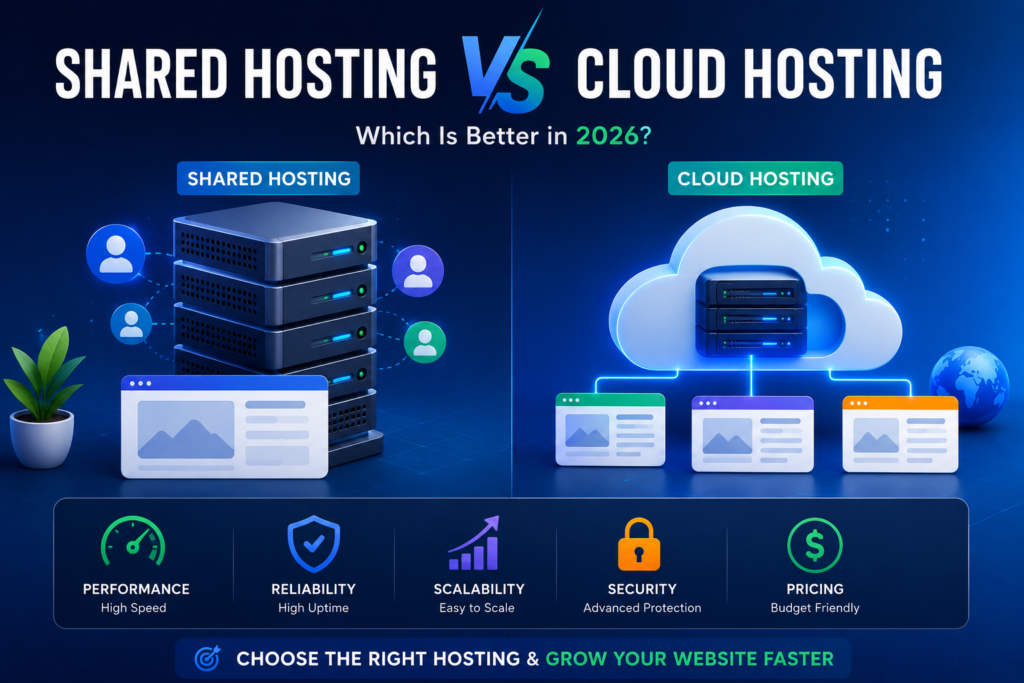
Shared Hosting vs Cloud Hosting: Which Is Better in 2026?

Shared Hosting vs Cloud Hosting

Introduction:

Choosing the right hosting is one of the most important decisions for any website owner. Whether you are starting a blog, business website, online store, or portfolio, your hosting directly affects speed, uptime, security, and user experience.

Two of the most popular hosting options today are Shared Hosting and Cloud Hosting. While both can host your website, they work in different ways and are designed for different needs.

In this guide, we’ll compare shared hosting and cloud hosting to help you choose the best option for your website in 2026.

What Is Shared Hosting?

Shared hosting is a hosting environment where multiple websites share the same server and its resources.

Think of it like living in an apartment building. You have your own apartment, but you share the building’s resources with other residents.

Because resources are shared, hosting companies can offer shared hosting at a very affordable price.

Shared Hosting Advantages

  • Low monthly cost
  • Beginner-friendly
  • Easy website management
  • Usually includes cPanel
  • Ideal for small websites

Shared Hosting Disadvantages

  • Limited performance during traffic spikes
  • Shared resources can affect speed
  • Less flexibility
  • Not ideal for large or high-traffic websites

Best For

  • Personal blogs
  • Portfolio websites
  • Startup websites
  • Small business websites
  • Beginners
Best Hosting for Small Business

What Is Cloud Hosting?

Cloud hosting uses multiple connected servers instead of relying on a single server.

Rather than storing your website on one machine, your website runs on a network of servers that work together. If one server experiences an issue, another server can continue serving your website.

This setup improves performance, uptime, and scalability.

Cloud Hosting Advantages

  • Faster performance
  • Better uptime
  • Easy resource scaling
  • Improved reliability
  • Better handling of traffic spikes

Cloud Hosting Disadvantages

  • Higher cost than shared hosting
  • Can be more complex for beginners
  • Resources may cost more as your website grows

Best For

  • Growing businesses
  • E-commerce websites
  • High-traffic websites
  • Agencies
  • Business-critical websites

Shared Hosting vs Cloud Hosting: Key Differences

Performance

Shared hosting uses the same server resources for many websites. If one website experiences heavy traffic, other websites on the server may be affected.

Cloud hosting distributes resources across multiple servers, providing more stable and consistent performance.

Winner: Cloud Hosting

Shared Hosting vs Cloud Hosting

Speed

Website speed is important for both user experience and SEO.

Cloud hosting typically delivers faster loading times because resources are allocated more efficiently.

Shared hosting can still be fast, especially when combined with LiteSpeed servers and SSD storage, but cloud hosting generally performs better under load.

Winner: Cloud Hosting

Shared Hosting vs Cloud Hosting

Uptime

Uptime measures how often your website remains online.

With shared hosting, a server issue can affect every website hosted on that server.

Cloud hosting reduces this risk because multiple servers work together.

Winner: Cloud Hosting

Shared Hosting vs Cloud Hosting

Scalability

As your website grows, you may need more resources.

Shared hosting plans usually have fixed limits.

Cloud hosting allows you to increase resources without migrating your website to a new server.

Winner: Cloud Hosting

Pricing

Pricing is where shared hosting shines.

Shared hosting is significantly more affordable and is often the best starting point for new websites.

Cloud hosting costs more because it offers better performance and flexibility.

Winner: Shared Hosting

Security

Both hosting types can be secure when managed properly.

However, cloud hosting often provides stronger infrastructure and better isolation between accounts.

Shared hosting environments may have higher risks if another website on the same server is compromised.

Winner: Cloud Hosting

Feature Comparison

Feature Shared Hosting Cloud Hosting
Price Lower Higher
Speed Good Excellent
Uptime Good Excellent
Scalability Limited High
Security Good Better
Traffic Handling Limited Excellent
Beginner Friendly Yes Yes


Which Hosting Should You Choose?

Choose Shared Hosting If:

  • You are launching your first website
  • You have a limited budget
  • Your website receives low to moderate traffic
  • You need a simple hosting solution

Shared hosting is a practical and affordable option for most new website owners.

Choose Cloud Hosting If:

  • Your website is growing rapidly
  • You expect higher traffic
  • Website performance is a priority
  • You run an online store or business website
  • You need maximum uptime and reliability

Cloud hosting is a better long-term solution for websites that require stronger performance.

Shared Hosting vs Cloud Hosting

Final Verdict

There is no single winner for every website.

Shared Hosting is ideal for beginners, startups, blogs, and small websites that need affordable hosting.

Cloud Hosting is better for growing businesses, e-commerce stores, and websites that require higher speed, reliability, and scalability.

If you are just getting started, shared hosting can be the perfect first step. As your website grows, upgrading to cloud hosting can help you maintain fast performance and provide a better experience for your visitors.


For lightning-fast speeds, maximum uptime, and premium performance, consider upgrading your website to GenShift’s high-quality Cloud Hosting.

Cloud Hosting


Frequently Asked Questions

Is cloud hosting faster than shared hosting?

Yes. Cloud hosting generally offers better speed and performance because resources are distributed across multiple servers.

Is shared hosting good for small businesses?

Yes. Shared hosting is often the most cost-effective option for new and small business websites.

Can I upgrade from shared hosting to cloud hosting later?

Yes. Most hosting providers allow you to upgrade your hosting plan as your website grows.

Which hosting is better for SEO?

Website speed and uptime affect SEO. Because cloud hosting usually performs better in both areas, it can provide SEO advantages.

Need Other Article?

How Much RAM Does a Website Need? Hosting Guide

Can You Create a Business Email Without a Website? 7 Easy Steps

Scroll to Top